
 English
 日本語
日本語
 한국어
한국어
 Dansk
Dansk
 Nederlands
 Italiano
 Español
 Árabe
Árabe
 Português
 Türkçe
 Deutsch
 Русский
 Français
 Prancis
 ไทย
ไทย
 Tiếng Việt
 हिंदी
हिंदी
 বাংলা
বাংলা

Comprehensive Guide to Impellers and Stirrings for Bioreactors& Fermenters
Stirring operations are applied across an extremely wide range of industries. Even within the biomanufacturing sector alone, beyond upstream fermentation and cell culture, stirring is extensively used in solution preparation, downstream purification, pre-harvest processing, formulation manufacturing, and environmental treatment. It enables critical processes including material dissolution and mixing, precipitation and crystallization, emulsification and dispersion, inactivation reactions, and solid-liquid homogenization, making it a key operation throughout the entire production workflow.
This article specifically focuses on fermenters and bioreactors used in upstream cultivation, namely mechanically agitated fermenters and stirred-tank bioreactors, as illustrated in the figure below.

The stirring system is undoubtedly the core component of fermenters and bioreactors, playing an irreplaceable and critical role in process performance. This article will explore the various impeller types of this key component in detail.
Common Impeller Types and Technical Introduction(Classification by Flow Direction)
Impellers are primarily categorized by flow pattern into three main types: radial flow, axial flow, and mixed flow. Their basic descriptions, representative types, performance characteristics and application scenarios are detailed in the table below:
Classification | Core Flow Characteristics | Representative Impeller Types | Key Performance Features | Typical Application Scenarios |
Radial Flow Impeller | Fluid flow direction is perpendicular to the stirring shaft, jets outward along the radial direction, and splits into upward and downward circulating flows after impacting the tank wall. | 1. Six Straight Blade Disc Turbine (Rushton Turbine) | Advantages: Strong shear force, excellent bubble breaking capacity, highest gas-liquid dispersion and dissolved oxygen (kLa) efficiency. | Fermentation processes insensitive to shear force and requiring high oxygen demand: |
Axial Flow Impeller | Fluid flow direction is parallel to the stirring shaft, forming a large up-down circulation throughout the tank. | 1. Propeller (Helical) Impeller | Advantages: Large circulation discharge rate, good mixing uniformity throughout the tank, mild shear force, low power consumption. | Systems sensitive to shear force and requiring good mixing: |
Mixed Flow Impeller | Simultaneously generates significant axial and radial flows, being a composite of the two flow patterns. | 1. Wide Blade Hydrofoil Impeller (e.g., Lightnin A310) | Advantages: Balances good mixing, moderate dissolved oxygen capacity and low shear force, high comprehensive performance, low energy consumption. | Modern processes requiring balanced multiple performances: |
Detailed Introduction to Typical Impeller Types
1. Rushton Impeller - Standard Six Straight Blade Disc Turbine
This is widely recognized as the most classic impeller type. The Rushton impeller is a typical radial flow stirring impeller. With its six flat blades and central disc structure, it can generate intense radial shear and gas-liquid shear effects, delivering excellent bubble breaking capacity and high dissolved oxygen efficiency. It is the classic impeller type for traditional aerobic fermentation processes.
Lightnin
| Chemineer
| EKATO |
|
|
|
R100 | D6 | Rushton |
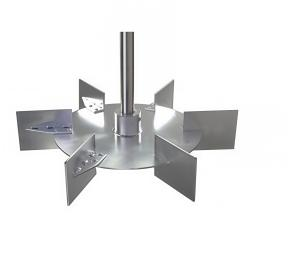
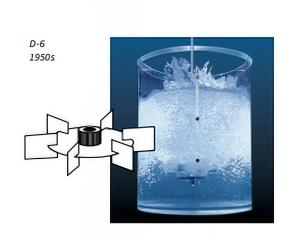
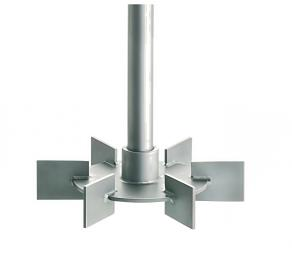
2. Six Pitched Blade Disc Turbine
The six pitched blade disc turbine is a mixed flow impeller type improved based on the standard Rushton impeller. By adopting a central disc paired with 45° pitched blade design, it retains excellent gas-liquid dispersion performance while significantly enhancing axial circulation capacity and overall mixing efficiency. It is a versatile and classic selection suitable for various aerobic fermentation processes and high-viscosity systems.

3. Smith Turbine Series
The Smith Turbine is a six-blade radial flow turbine with a disc, which can be understood as a curved blade improved version of the Rushton turbine. It is specially designed to enhance gas-liquid dispersion, resist flooding, and reduce power consumption attenuation under aeration conditions, making it one of the mainstream high-shear radial impellers for fermentation and aerobic reaction processes. This series includes a wide variety of designs.
The semi-circular blade type (non-strictly semi-circular, belonging to the same series) is the commonly known R130/CD-6 and other models:
Brand | Lightnin
| Chemineer
| EKATO |
Photo for reference |
|
|
|
Model | R130 | CD-6 | PHASEJET |
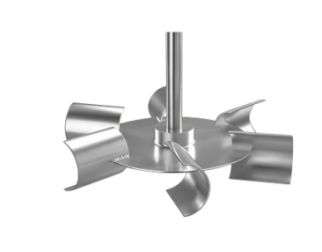
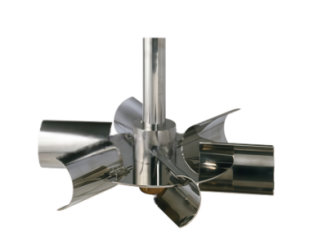
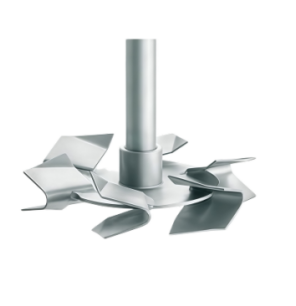
There are many other design variations, such as curved blade, arrow blade, and other customized shapes, which will not be elaborated on here.
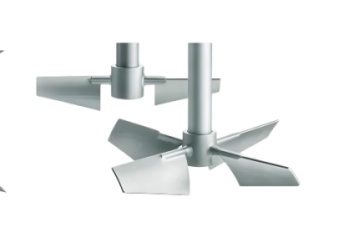
4. Open Turbine
Unlike the disc turbine agitators introduced previously, the open turbine has no central disc. The blades are of open design and directly connected to the hub.
According to blade shape, conventional open turbines are mainly divided into three types:
· Flat Blade Type: Blades are flat rectangular shape
· Curved Blade Type: Blades are curved backward
· Pitched Blade Type: Blades are inclined at a certain angle (usually 45° or 60°) to the vertical plane of the stirring shaft

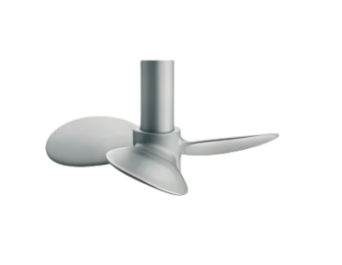
5. MARINE - Propeller Type Impeller
The MARINE impeller (marine propeller type stirring impeller, referred to as marine propeller/propeller impeller) is the most classic high flow rate, low shear, pure axial flow stirring impeller. Its structure imitates a ship propeller, and it realizes full tank circulation mainly through axial pushing, which is a completely different impeller category from turbine types (Rushton, Smith, PBT).
Brand | Lightnin
| Chemineer
| EKATO |
Photo for reference |
|
|
|
Model | A100 | JP-3
| MARINE |
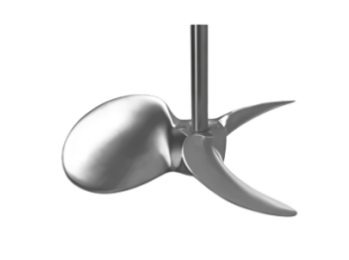
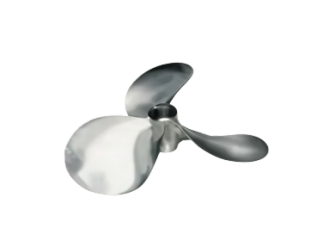
6. Hydrofoil Impeller
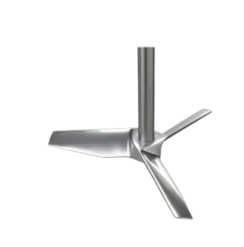
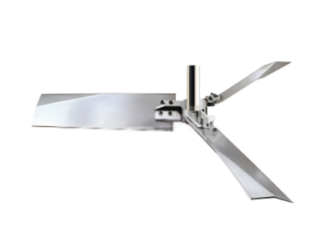
The hydrofoil axial flow impeller, referred to as hydrofoil impeller, is a high-end axial flow stirring impeller specially designed for high efficiency, low energy consumption and gentle mixing. The blades adopt an aircraft wing cross-section shape, and it realizes uniform mixing throughout the tank mainly through high flow rate axial circulation. It is the mainstream impeller type for modern bioreactors, with obvious structural and performance differences from traditional propeller impellers, pitched blade turbines and radial disc turbines.
Brand | Lightnin
| Chemineer
| EKATO |
Photo for reference |
|
|
|
Model | A310/A510 | HE-3/HE-4
| VISCOPROP |
7. Extended Type - Wide Blade Hydrofoil Axial Flow Impeller
(As shown in below)

8. Pfaudler - Three-Blade Swept Back Impeller
The three-blade swept back stirring impeller, sometimes directly referred to as "swept back type" or "Pfaudler type" stirring impeller, usually has three blades. The blade shape is curved backward (i.e., "swept back"), and the blade cross-section is usually diamond or airfoil shape. This swept back design can reduce resistance and optimize flow performance. It mainly generates radial flow. However, technical documents specifically point out that when used with finger baffles, it can achieve good up-down circulating flow, thus combining the advantages of radial dispersion and axial mixing.

9. Elephant Ear Impeller
The elephant ear impeller is introduced separately here because it is widely used in industrial applications. Some technical documents classify it into the broad category of hydrofoil impellers, but it has distinct differences from standard hydrofoil designs.
In simple terms, the elephant ear impeller is a specific variant designed in industrial practice to achieve the high-efficiency, low-shear axial flow of the "hydrofoil type", while its flow pattern is a unique "mixed flow".

10. MIG - Multi-Stage Counter-Flow Impeller and Improved Variants
The multi-stage counter-flow agitator is composed of multiple (usually 2-3 layers) staggered inclined blades, with the blades meshing with each other or having very small gaps, which can generate intense axial circulation and counter-flow.
It is introduced separately because the MIG impeller is mainly designed for processing medium to high viscosity and even ultra-high viscosity materials, especially high viscosity non-Newtonian fluids in laminar and transition flow states, such as polymer solutions, resins, cosmetics, food slurries, etc.
Common applications in the biological fermentation field:
· Filamentous fungi/actinomycetes fermentation: Suitable for fermentation processes with high viscosity and sensitivity to shear force.
· Plant cell culture: Technical documents mention that Intermig impellers (similar in principle to MIG) have been tested in plant cell suspension culture, with reported advantages of low shear force, good mixing, excellent gas diffusion and low energy consumption.
· Animal cell culture: Relevant technical documents discuss it as a low shear force option, but it is usually not the most mainstream choice (propeller type, pitched blade impeller, elephant ear impeller are more common).
· Special processes: Suitable for processes where viscosity gradually increases with the reaction, such as solution polymerization or bulk polymerization reactions.

There are many other impeller types available on the market, such as perforated impellers, anchor type, frame type, etc., which will not be introduced one by one here. With the above understanding of common impeller types, we can proceed to discuss the selection criteria for impellers in different process scenarios.
